
'2022 has not been -- and will not be -- the kind of 2021 bull market, which lifted all boats.'

Benchmark BSE Sensex and Nifty closed on a flat note after a volatile session on Wednesday profit booking in IT and realty shares negated gains in metal and oil & gas stocks. The 30-share BSE Sensex ended 35.78 points or 0.06 per cent lower at 58,817.29, while the broader NSE Nifty inched 9.65 points or 0.06 per cent higher at 17,534.75. The market remained range-bound for the most part of the session as investors kept their exposure low due to weak global cues, traders said.

Rising crude oil prices and muted passenger traffic in the July-September quarter (second quarter, or Q2) of 2023-24 (FY24) have raised concerns about the profitability of listed aviation players. These two concerns have caused the stock of InterGlobe Aviation (IndiGo), the largest player in the sector, to slip by 11 per cent since its highs at the end of July. Nuvama Research expects yields to cool down in the near term due to seasonality, rising crude oil prices, and higher capacity.

Improving economic sentiment, enabling policies and growth in key emerging sectors may help attract 30 per cent more private equity funds at $6 billion in the realty sector next year compared to 2020, says a report. PE investments into the realty space is expected to dropped to $4.6 billion in 2020 due to decline in the overall economic activity hit by the pandemic-driven lockdowns, according to a report by global property consultancy Savills India. The next wave of investments will be driven by warehousing, affordable housing and data centres apart from commercial office which will continue to see steady improvement, says the report.

Markets continued to fall on Monday, with the Sensex declining 94 points as investors remained cautious amid unabated selling by foreign funds and elevated crude oil prices ahead of the RBI's policy decision later this week. The 30-share BSE Sensex declined 93.91 points or 0.17 per cent to end at 55,675.32. During the day, it tanked 473.49 points or 0.84 per cent to 55,295.74.

According to HSBC, the volatility in Indian markets since May can be attributed to the initial talk about tapering of bond purchase by the US Federal Reserve but the catalyst for recent volatility in Indian equities was when policymakers decided to tighten liquidity to stem capital outflows.

Telecom infrastructure player Indus Towers has been largely ignored by investors with occasional bursts of trading when there's news flow. For example, the stock fell from Rs 188 (Jan 1, 2023) to Rs 135 (Jan 27) and then bounced back to Rs 165 in early February as the Government of India (GoI) converted Vodafone Idea's (Vi) debt into equity and Bharti Airtel pushed up its direct stake in Indus to 47.95 per cent. The cash-strapped Vi holds 21 per cent stake in Indus Towers and Indus also has substantial receivables to come in from Vi which is a negative overhang.

Benchmark equity indices Sensex and Nifty reversed their early gains to close lower on Wednesday due to selling in oil & gas, banking and IT stocks amid weak trends in European markets. The 30-share BSE Sensex declined by 372.46 points or 0.69 per cent to close at 53,514.15, extending its falling streak to a third day. The index opened higher and touched the day's high of 54,211.22 amid gains in Asian markets.

Tyre stocks have been on a tear over the past six months, with average returns exceeding 45 per cent. Except for Apollo Tyres, which has seen a slight correction in the last month and a half, limiting its gains to 16 per cent, listed peers such as MRF, CEAT Tyres (formerly Cavi Elettrici e Affini Torino), and JK Tyre & Industries have delivered returns exceeding 30 per cent during this period. Production-related constraints and sluggish demand in Europe, where sales are expected to remain flat, coupled with high valuations, have contributed to Apollo Tyres' underperformance. The tyre sector's gains can be attributed to robust growth trends driven by the replacement market, which constitutes more than two-thirds of sales.

Foreign investment in India's start-ups has plummeted 72 per cent to $4.58 billion so far, from $16.2 billion during the same period last year.

India's current account deficit narrowed to $1.3 billion or 0.2 per cent of GDP in the January-March quarter of FY23, mainly due to moderation in the trade deficit and a robust increase in services exports, RBI data showed on Tuesday. However, for the 2022-23 fiscal, the current account balance recorded a deficit of 2 per cent of GDP compared to 1.2 per cent in 2021-22. "India's current account deficit (CAD) decreased to $1.3 billion (0.2 per cent of GDP) in Q4:2022-23 from $16.8 billion (2.0 per cent of GDP) in Q3:2022-231, and $13.4 billion (1.6 per cent of GDP) a year ago [Q4:2021-22]," as per the RBI's 'Developments in India's Balance of Payments during the Fourth Quarter (January-March) of 2022-23'.

From the 30-share basket, 28 scrips suffered losses. Over 200 stocks were at their 52-week low in Tuesday's trade.

According to Standard & Poor's index services monthly global stock market review, global equity markets after three months of consecutive gains declined 0.58 per cent in June with emerging markets giving negative returns of 1.45 per cent. Indian stock markets gave the highest returns of as much as 60.6 per cent in the three months period between April to June, despite witnessing a loss of 2.17 per cent in the month of June.

'Yet the market didn't do all that badly because it was cushioned by domestic inflows.'
Domestic equity investors' wealth eroded by more than Rs 4.43 lakh crore on Monday as fears of a financial contagion triggered by one of the biggest bank failures in the US roiled market sentiments. After a strong opening, Indian stocks went into a tailspin with the benchmark 30-share BSE Sensex tumbling nearly 900 points to close at 58,237.85 points -- sliding for the third straight trading session. The NSE Nifty too declined 258.60 points to end at 17,154.30 points.

In 2012, private equity investments touched $7.5 billion.

Public-sector enterprise stocks have seen a good run thus far in 2023-24 (FY24), with the S&P BSE PSU Index surging by over 26 per cent during the period, compared to an 11 per cent increase in the benchmark S&P BSE Sensex.

The legal battle between Byju's and lenders in the US on the edtech firm's $1.2-billion term loan B (TLB), along with the company skipping an interest payment of $40 million on the loan, has made the other investor Davidson Kempner Capital Management, "extremely concerned", according to the people familiar with the matter. They said Byju's has closed a Rs 2,000-crore ($250 million) round from the US-based investment firm and it may stop or consider slowing down the flow of various tranches of that capital to the company. It may also decide not to provide any new funding or participate in any such round in the future, the sources said.

On the Sensex chart, IndusInd Bank, SBI, Dr Reddy's, NTPC, ICICI Bank, HCL Tech and Bajaj FinServ emerged as major laggards.

A bench of Justices Sanjiv Khanna and MM Sundresh said the word 'cruelty' under Section 13(1)(ia) of the Hindu Marriage Act of 1955 has no fixed meaning, and therefore, gives a very wide discretion to the Court to apply it "liberally and contextually".
Equity investors became poorer by over Rs 8 lakh crore in five days of market plunge. The BSE benchmark has lost 2,062.99 points or 4 per cent in five trading sessions. On Thursday, the 30-share BSE benchmark tanked 585.10 points or 1.17 per cent to close at 49,216.52. Following the bearish trend, the market capitalisation of BSE-listed companies declined by Rs 804,216.71 crore to Rs 2,01,22,436.75 crore in five days.
Equity indices fell on Thursday, mirroring weak global market trends following the US Federal Reserve's interest rate hike and hawkish stance. The 30-share BSE Sensex declined 337.06 points or 0.57 per cent to settle at 59,119.72. During the day, it tanked 624 points or 1.04 per cent to 58,832.78. The NSE Nifty went lower by 88.55 points or 0.50 per cent to end at 17,629.80.

From the 30-share Sensex pack, 23 scrips declined in Wednesday's session, led by IndusInd Bank, Bajaj Finance, Tata Motors and Tata Steel which fell by up to 3.87 per cent.

Despite the current bout of volatility, debt-oriented hybrid funds remain well suited for risk-averse investors.

Equity benchmarks Sensex and Nifty on Thursday gave up all early gains to settle lower as surging oil prices amid the ongoing conflict between Russia and Ukraine hit investor sentiment. The 30-share BSE Sensex started the trade on a higher note and jumped 527.72 points in morning deals to a high of 55,996.62. However, during the afternoon trade it surrendered all its early gains and finished at 55,102.68, lower by 366.22 points or 0.66 per cent.

The rupee plunged 20 paise to close at an all-time low of 78.13 against the US dollar on Monday, as a lacklustre trend in domestic equities and stronger greenback overseas weighed on investor sentiments. Forex traders said weak Asian currencies and persistent foreign capital outflows were the other major factors that dragged the local unit down. At the interbank foreign exchange market, the local currency opened at 78.20 and witnessed an intra-day high of 78.02 and a low of 78.29 against the US dollar.

FIIs have offloaded stocks worth Rs 13,110 crore
Stick to disciplined investing. Do your homework thoroughly before committing your funds or you will be speculating. This is not advisable on both counts of managing risk and enhancing returns. Preferably, add companies that are leaders in their respective businesses. The companies should have reasonably decent prospects, sound management and strong entry barriers, apart from healthy financials that will help them tide the current rough patch.

The health of Indian banks continued to improve in 2021-22 with their balance sheet growing at double digits after a gap of seven years and their asset quality and capital position bettering, the Reserve Bank of India (RBI) said in its annual report on trend and progress of banking in India. At the same time, the banking regulator flagged the issue of slippages from restructured accounts. "Going forward, it is imperative that banks ensure due diligence and robust credit appraisal to limit credit risk," the report said.

The market breadth ended weak on the BSE with 2,086 shares declining and 893 shares advancing.

Decline in hiring is not a surprise and is consistent with slowdown in growth rates and efforts of Indian IT to drive up productivity, says the report

Mergers & acquisitions started off on a strong footing, hitting a four-year high at $30.3 billion in the first quarter of 2022, bucking the global trend where deal-making fell sharply, says a report. Deal activity grew by 5.6 per cent in value terms in January-March 2022 compared to the first quarter of 2021, making it the highest first-quarter period since 2018 when it was $31.1 billion. In volume terms, the M&A activity grew 29.6 per cent in the first quarter of 2022, making it the best-ever quarterly number, according to the M&A numbers collated by Refinitiv, an LSEG business, which is among the world's largest providers of financial markets data and infrastructure. M&As involving domestic companies stood at $23.7 billion, down 8.3 per cent on year.

The trade-war between the US and China is prompting investors to flee from risky assets, such as equities, to safe-haven bets, such as gold and treasuries
.jpg)
The benchmark has gained 2 per cent this week on continued hopes the incoming Narendra Modi government would unveil substantial economic reforms.

The markets may be entering a consolidation phase and are expected to trade sideways for now after a good run in the last few weeks, suggest analysts. In this backdrop, they suggest investors can book profits at the current levels and enter the market again on a decline from a medium-to-long term perspective. Thus far in fiscal 2023-24 (FY24), the S&P BSE Sensex has moved up around 5 per cent to nearly 62,000 levels.

Tata Steel was the top gainer in the Sensex pack, jumping over 6 per cent, followed by Sun Pharma, L&T, M&M, PowerGrid, Bajaj Finserv, TCS and Infosys. On the other hand, Wipro, Asian Paints, HDFC Bank, IndusInd Bank and HCL Tech were among the laggards.

Trading in Samvat 2074 on Thursday got off to a rocky start, with the benchmark indices ending more than half a percent lower and the gauge for banking stocks dropping 1.25%.

There is polarisation among sectors with IT and healthcare receiving the lion's share of FPI money in the past two quarters.
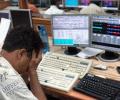
Titan, Maruti Suzuki India, Asian Paints, Mahindra & Mahindra and Hindustan Unilever Limited were the biggest drags on the Sensex, tumbling up to 5.05 per cent. In contrast, ITC, Dr Reddy's Laboratories, Tech Mahindra and UltraTech Cement were among the gainers.

Lower crude oil prices would impact India's inflation, CAD.
